

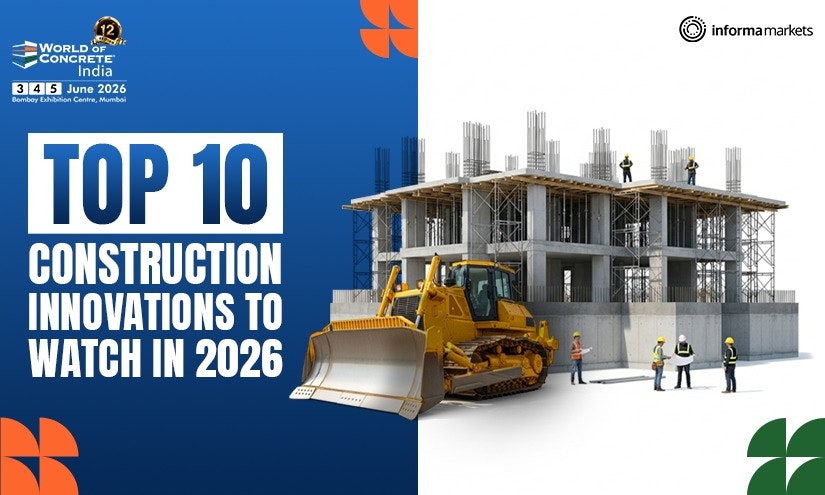
Top 10 Construction Innovations to Watch in 2026
The global construction landscape is rapidly evolving, and India stands at the forefront of this transformation. With rising urbanization, infrastructure demands, and sustainability goals, the construction industry is embracing cutting-edge innovations that redefine how projects are designed, built, and operated. As we step into 2026, here are the Top 10 Construction Innovations that industry leaders, builders, and stakeholders must watch. 1. Modular and Prefabricated Construction Prefabrication and modular construction continue to gain traction in India and globally. These methods involve producing building components off-site in controlled environments and assembling them on-site. The benefits are profound: faster construction schedules, reduced material wastage, lower labor dependency, and improved quality control. In urban projects where deadlines are tight and land costs high, modular solutions help deliver residential, commercial, and institutional buildings faster and more efficiently. The shift toward modular bathrooms, façade systems, and even entire living units is expected to accelerate in 2026. 2. 3D Printing of Concrete Structures Concrete 3D printing is no longer an experimental technology, it’s becoming a practical reality for industrial and residential construction. By extruding high-strength concrete layer by layer, large structures can be built with significantly less labour, waste, and time. For India, where affordable housing is a priority, 3D printing can play a pivotal role. Builders are exploring printed walls, structural elements, and customized architectural features. As the technology matures, expect new standards for material mixes, print speed, and integrated utilities for smart buildings. 3. Robotics and Automation on Jobsites Automation has entered construction sites through drones, autonomous machinery, and robotic arms. These technologies enhance precision, improve safety, and reduce human strain. Drones conduct site surveys and progress monitoring, while robotic bricklayers and rebar folders increase speed and quality. In 2026, jobsite robots will be more collaborative, working alongside human crews to automate repetitive tasks like excavation, welding, and finishing. This hybrid workforce approach will help Indian contractors address labor shortages and meet quality expectations more consistently. 4. Digital Twins and Metaverse Integration Digital twin technology creates virtual replicas of physical structures and systems. By integrating real-time data with simulation models, teams can optimize building performance, predict failures, and reduce operational costs. Coupled with early concepts from the metaverse, stakeholders can conduct immersive walkthroughs, clash detection, and scenario planning long before ground is broken. For complex infrastructure like metro systems, airports, or industrial plants, digital twins enhance coordination and reduce costly rework. 5. Green Concrete and Low-Carbon Materials Sustainability has moved from buzzword to business imperative. The construction industry is among the biggest contributors to carbon emissions, pushing innovators to develop low-carbon concrete and eco-friendly materials. Green concrete, produced with reduced cement content, recycled aggregates, or alternative binders, offers comparable strength with a lower environmental footprint. Beyond concrete, materials like engineered timber, geopolymer composites, and bio-based insulation are becoming more viable choices for builders seeking certifications like IGBC, LEED, and GRIHA. 6. Advanced Sensor Networks for Smart Buildings The proliferation of IoT and sensor technology is enabling smarter buildings that think, adapt, and communicate. Sensors embedded in structural elements monitor temperature, load, vibration, and humidity, offering predictive insights about maintenance needs. Smart concrete embedded with conductive fibers or micro-sensors is emerging as a game-changer for safety and longevity. Facility managers can now detect early signs of distress or degradation, reducing lifecycle costs while improving occupant comfort and safety. 7. Augmented Reality (AR) and Wearables for Enhanced Safety Safety remains a top priority in construction sites. Augmented reality (AR) and wearable tech are transforming how safety protocols are enforced. Workers equipped with AR helmets or glasses can visualize hazards, receive training overlays, or view digital instructions in real time. Wearables with biometric tracking can monitor fatigue, posture, and exposure to environmental hazards, triggering alerts to prevent accidents. In 2026, expect widespread adoption of AR and wearables in training, onsite decision-making, and compliance reporting. 8. Sustainable Concrete Curing Techniques Concrete curing, the process of maintaining adequate moisture and temperature, is critical to achieving strength and durability. Traditional curing methods like water curing or membranes have limitations in efficiency and water use. Innovations such as spray-on curing compounds, curing blankets, and micro-encapsulation of curing agents are gaining attention. These methods not only conserve water but also accelerate strength gain, allowing faster formwork turnaround and optimizing project timelines. 9. AI-Driven Project Management and Predictive Analytics Artificial Intelligence (AI) is reshaping project planning, risk assessment, and execution. AI algorithms can analyze historical data, detect patterns, and forecast delays, cost overruns, and resource constraints. Machine learning tools help teams optimize schedules, logistics, and supply chains with unprecedented accuracy. In 2026, construction firms will increasingly rely on AI-driven dashboards to make real-time decisions, manage large portfolios, and enhance productivity across multi-site operations. 10. Energy-Generating and Self-Healing Materials Looking beyond conventional materials, researchers are developing energy-generating and self-healing construction solutions. Solar facades, photovoltaic glass, and kinetic pathways can turn buildings into power producers. Meanwhile, self-healing concrete, embedded with bacteria or microcapsules, can autonomously fill cracks, extending the life of structures and reducing maintenance costs. These futuristic materials are rapidly transitioning from labs to pilot projects and are expected to appear in mainstream construction by 2026, especially in infrastructure, bridges, and high-performance buildings. Conclusion The construction industry in India is on the verge of a transformation powered by innovation. From digital tools and robotics to sustainable materials and smart systems, the technologies highlighted above promise faster delivery, better quality, lower costs, and reduced environmental impact. For stakeholders attending World of Concrete India, understanding and adopting these innovations will not just be a competitive advantage, it will define the future of construction in the region. Embracing these trends today sets the stage for resilient, efficient, and intelligent buildings of tomorrow. |
INFORMA ALLSECURE
To ensure safe and effective experience at the tradeshow
Informa launches �AllSecure�, an approach for enhanced health& safety standards at its events in the NEW NORMAL.
Whether they are exhibitors, attendees, visitors, speakers or sponsors, customers come to events to connect, learn, know more and to do business effectively, safety & confidence. To conduct physical trade exhibitions amidst the new normal, Informa Markets in India has created the �AllSecure� safety standard. A detailed set of enhanced measures, AllSecure provides attendees the reassurance and confidence that they are participating in a safe and controlled environment. These international protocols are based on the broader principles of Physical Distancing, Protect & Detect, Cleaning & Hygiene and detailed Communications on these principles. It includes a commitment to ten key priorities across all Informa events, as well as fuller range of standards & recommendations that will be followed at our events wherever applicable & possible.

FOR BOOKINGS & PARTNERSHIP OPPORTUNITIES

Saiprasad Terde
📞+91 99200 50415
✉ saiprasad.Terde@informa.com

Iyer Narayanan
📞 +91 99673 53437
✉ iyer.narayanan@informa.com

Vinaykumar Naik
📞 +91 81475 59749
✉ Vinaykumar.Naik@informa.com
FOR SPEAKING OPPORTUNITY

Amit Sharma
📞 +91 99109 55222
✉ amit.sharma@informa.com
FOR MARKETING & STRATEGIC ALLIANCES

Pankaj Sharma
📞 +91 99713 65776
✉ pankaj.sharma@informa.com

Madhur Dave
📞 +91 70307 94902
✉ madhur.dave@informa.com

Shantanu Baraskar
✉ shantanu.baraskar.in@informa.com
INTERNATIONAL CONTACT FOR SPACE & PARTNERSHIP
Debora Baldinelli
📞 + 39 02 86897000
✉ info@invernizzigroup.com
Country: Italy
Company Name: Invernizzi International Sales
Website: www.invernizzigroup.com
Michael Pittscheidt
📞 0049 - 2251 - 8665658
✉ info@pittscheidt.de
Country: Germany
Company Name: Messe Marketing
Website: https://www.pittscheidt.de
Website by: Xpoteck
Your feedback matters!
Please take a moment to rate our business on Google and share your experience with us.